An Evening with Ramanujan

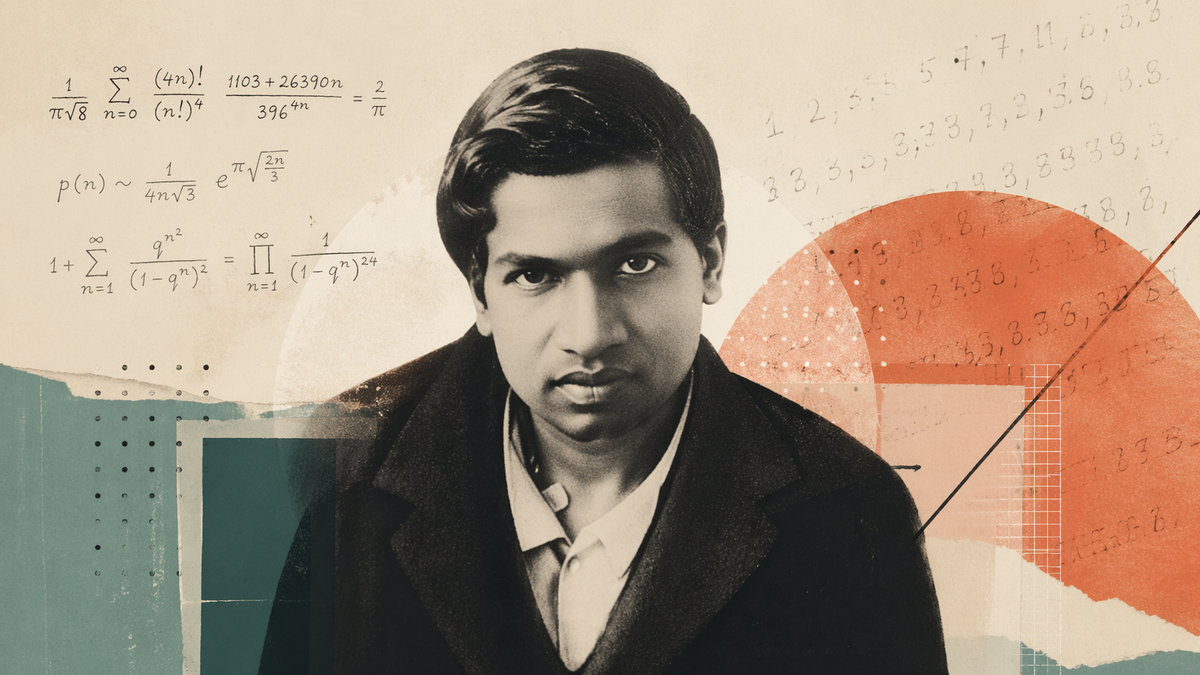
On Friday April 17th, we hosted Professor Krishnaswami Alladi, a long-time professor of mathematics at the University of Florida. In the landscape of modern number theory, some mathematicians produce results, while others help preserve and extend intellectual legacies. Professor Alladi stands out for doing both, with a particular commitment to the enduring influence of Srinivasa Ramanujan, maybe most well-known from the amazing 2015 film The Man Who Knew Infinity.
A mathematician formed through exchange
Krishnaswami Alladi was born in 1955 in India and entered the mathematical world through an act of pure initiative. As an undergraduate, he wrote to Paul Erdős, which led to a meeting, collaboration, and eventually several joint papers. This early connection placed Alladi within a tradition shaped by dialogue, problem-sharing, and collaboration.
This origin is significant. It reflects a model of mathematics as a shared enterprise, where ideas circulate across individuals and generations. Erdős embodied this culture, and Alladi carries it forward with a focus that includes both research and historical awareness. That's why we were over the moon to have him give the distinguished lecture about the life and work of Ramanujan.
Ramanujan as an active influence
Ramanujan is often described in almost legendary terms, celebrated for his intuition and originality. Alladi’s work brings a different perspective by situating Ramanujan within ongoing mathematical practice.
In 1997, Alladi founded The Ramanujan Journal, dedicated to areas influenced by Ramanujan’s work. This initiative created a structured venue for research inspired by Ramanujan’s ideas. The journal does more than commemorate; it sustains a community of inquiry built around themes that Ramanujan helped define.
This approach presents Ramanujan as an active presence in mathematics. His contributions are not treated as isolated achievements but as starting points for continued exploration.
Interpretation as part of mathematics
Alladi’s engagement with Ramanujan includes careful interpretation and contextual study. In his book Ramanujan’s Place in the World of Mathematics, he examines Ramanujan alongside figures such as Fermat and Galois, drawing comparisons in style, creativity, and historical context.
This comparative perspective clarifies the nature of Ramanujan’s work. It highlights his exploration of partitions, q-series, and identities that reveal unexpected connections. It also addresses the role of intuition in his discoveries, many of which appeared without formal proofs.
By placing Ramanujan in a broader intellectual setting, Alladi treats interpretation as a meaningful contribution. Understanding how mathematical ideas emerge and relate to one another becomes part of the discipline itself.
Extending a mathematical tradition
Alladi’s research contributions lie in number theory, especially in areas connected to Ramanujan’s work. His collaborations, including those with George Andrews, build on classical identities and extend them into new directions.
This work reflects continuity between intuition and rigor. Ramanujan’s insights often appeared in striking and unproven forms, while modern mathematicians provide formal structures that support and expand those insights. Alladi’s work operates within this framework, combining respect for original ideas with the demands of contemporary mathematics.
Mathematical stewardship
Beyond research, Alladi has taken on a broader role in shaping how Ramanujan’s legacy is understood. His efforts include editing a major journal, organizing conferences, and writing extensively on Ramanujan’s influence.
These activities contribute to the preservation and development of mathematical knowledge. They ensure that Ramanujan’s work remains part of active discussion rather than a historical curiosity.
A continuing presence
Ramanujan’s notebooks continue to inspire research more than a century after they were written. Alladi’s career invites reflection on how such influence persists. Mathematical ideas endure through ongoing engagement. They are revisited, extended, and reinterpreted by later generations. Through his research, editorial work, and scholarship, Alladi has played a central role in maintaining this process, helping to keep Ramanujan’s contributions firmly embedded in the living practice of mathematics.