Gödel's God and the Problem of Sourcehood

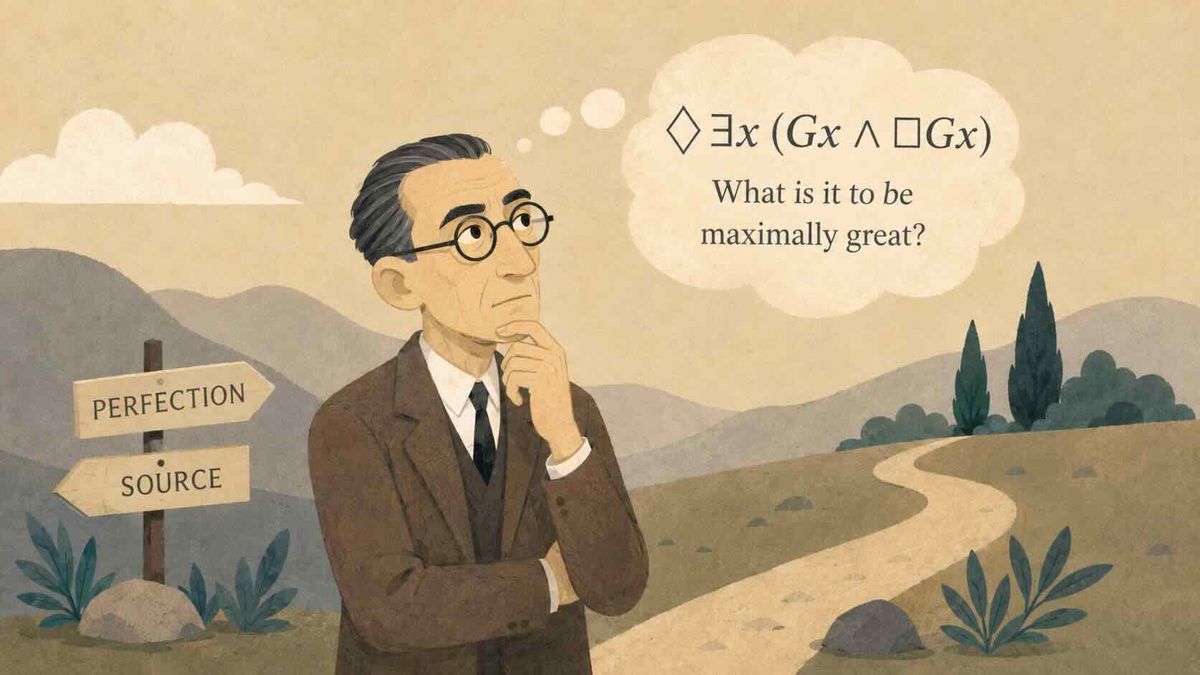
Kurt Gödel’s famous ontological argument begins with a strikingly simple idea: God is the being who possesses every positive property. Gödel is arguably one of the greatest logicians in history and his formulation had a certain elegance.
The legend goes that Gödel believed in God but was not about to admit that to his esteemed colleagues. So he formulated a series of proofs using (modal) logic that were just meant to stand on their own.
It takes the very old intuition that divinity means perfection and expresses it in a clean logical form. If power is positive, God has it. If knowledge is positive, God has it. If goodness, beauty, bliss, freedom, or necessity are positive, God has them too. "Godlikeness", as Gödel called it, becomes total possession of all perfections.
But there is a deeper question hiding underneath his definition.
Is the Supreme merely the one who has all divine qualities? Or is the Supreme also the original source from whom every other divine manifestation, energy, form, and being depends?
Those are not the same question.
The Problem with a List of Perfections
Perfect-being theology often thinks in terms of attributes. God is omniscient, omnipotent, perfectly good, necessary, eternal, and so on. The theological imagination builds upward by adding perfections until nothing greater can be conceived.
There is nothing wrong with that. It captures something real. A God who lacks wisdom, goodness, freedom, or fullness would not be God in any serious sense.
But a list of perfections does not yet tell us where those perfections come from.
Suppose there were a being who possessed every divine quality, but possessed them derivatively. Its fullness came from another. Its divinity was real, but received. It was complete in attributes, but not original in source-status.
Would that being be ultimate?
It would not seem so.
This is the distinction that matters: maximal qualification is not the same as metaphysical ultimacy. To be supreme is not only to have divine fullness. It is to be the unsourced source of whatever else has fullness.
Borrowed Fullness
The language of “borrowed” fullness can sound dismissive, but it need not be. A derivative manifestation may be genuinely divine. It may be radiant, inexhaustible, worthy of worship, and non-different from its source in an important sense.
The point is not that derivative means false. The point is that derivative means not original.
A flame lit from another flame is real fire. It burns. It illuminates. It is not an illusion. But there is still a direction of dependence. One flame came from another.
In the same way, a theology of divine expansion has to distinguish between having divine qualities and being the original source from whom divine qualities, forms, energies, and manifestations flow. Without that distinction, we collapse source and expansion into a single undifferentiated category.
That collapse may look tidy in logic, but it is bad theology.
Infinity Is Not Completeness
There is another subtle mistake here. We often assume that if something is infinite, it must be complete. But that does not follow.
An infinite set can still be a proper part of a larger whole. There can be no finite limit to something, and yet it may still not include everything.
That distinction is useful when thinking about divine manifestation. A manifestation may be inexhaustible without being the complete source. It may display unlimited glory, beauty, power, or presence, while still depending on another in its source-status.
This is not an attempt to reduce theology to mathematics. It is just a warning against a bad inference. “Infinite” does not automatically mean “ultimate.” “Inexhaustible” does not automatically mean “unsourced.”
The Supreme must be more than infinitely rich. The Supreme must be original.
Difference and Non-Difference
This also helps clarify one of the most difficult ideas in Bhāgavata Vedāntic theology: how something can be both different from and non-different from the Supreme.
If we state this crudely, it sounds like a contradiction: x is y and x is not y. But that is not the best way to understand it.
A divine expansion may be non-different from the source with respect to divine reality, power, or essence, while different with respect to role, form, manifestation, or source-status. The distinction is not between “same” and “not same” in a flat sense. It is between different respects of relation.
A wave is not other than the ocean in substance, but it is not the ocean as source. A ray is not other than the sun in luminosity, but it is not the sun as origin. These analogies are imperfect, as all analogies are, but they point toward the structure: genuine participation without total collapse.
The mystery remains. Logic does not dissolve it. But logic can at least prevent us from misunderstanding it.
The Source Matters
The deeper issue is that Western philosophical theology often asks, “What properties must God have?” Bhāgavata theology asks that question too, but it asks another one with equal force: “Who is the original source?”
That second question changes the whole structure.
If Godlikeness means only the possession of every positive property, then a derivative Godlike being remains possible. But if Godlikeness is meant to express ultimacy, then derivativeness must be excluded. The ultimate cannot receive ultimacy from another.
The Supreme is not simply the being with the greatest collection of divine attributes. The Supreme is the one whose fullness is not borrowed, whose being is not sourced, and from whom all derivative realities receive their place.
That is the difference between Godlikeness and sourcehood.
And it is not a minor technicality. It changes what we mean by “supreme.”