The Spud Cell Hype

How Close Are We to Creating Artificial Life?
Sensational headlines and viral media videos have recently declared a monumental breakthrough: scientists have supposedly created "synthetic life" or assembled a "cell built from scratch". The center of this media storm is "SpudCell," an artificial liposome system detailed in a massive 190-page bioRxiv preprint.
Very few news consumers will read a dense technical manuscript. Instead, most rely on bold media claims asserting that scientists have bridged the gap between non-living chemistry and biological life. But when we look past the headlines and examine the actual bioengineering, how close are we really to creating artificial life?
What Has Been Achieved: Defining SpudCell
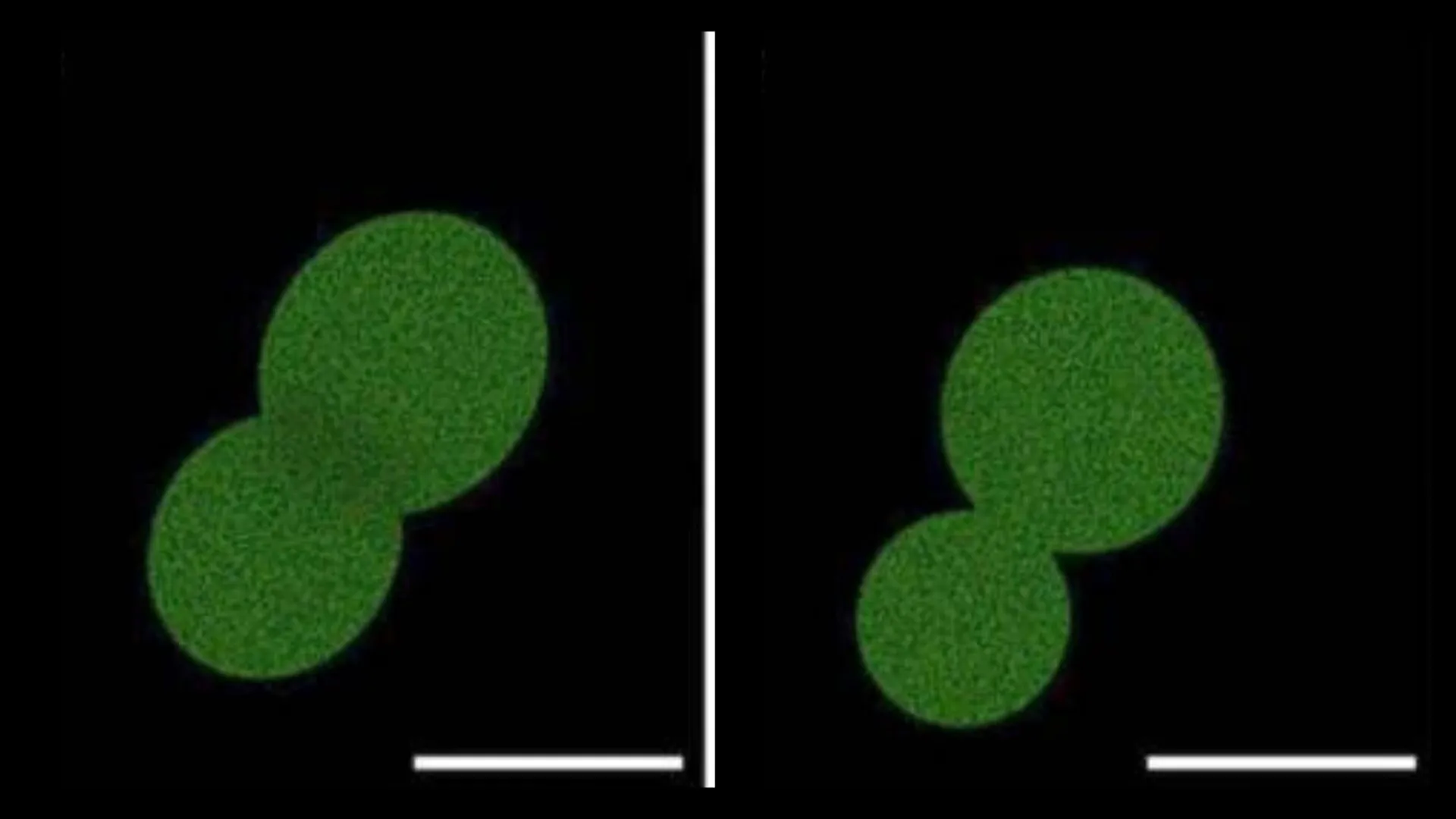
Engineered by Dr. Katarzyna Adamala and her team at the University of Minnesota, SpudCell is a synthetic lipid vesicle capable of undergoing selection, genome replication, growth, resource acquisition via feeding, and genetically encoded division with a minimal genome distributed across 7 to 8 DNA plasmids, totaling 90 kilobases (kb).
Credit must be given where it is due: SpudCell represents a remarkable feat of biochemical engineering. The researchers successfully coupled multiple molecular processes inside a liposome:
- Genome Expression & Replication: Using the PURE system (Protein Synthesis using Recombinant Elements) and Phi29 DNA polymerase, SpudCell can synthesise functional proteins, and replicate its plasmids.
- Feeding: SpudCell genome codes a membrane pore α-hemolysin (αHL) that allows it to fuse with smaller "feeder" liposomes.
- Selection: When a mutated plasmid variant encoding a higher expression of the pore protein was introduced, SpudCells carrying the mutation grew faster and produced more offspring, exhibiting a rudimentary form of natural selection.
- Cell division: Cell division is a goal of synthetic cell engineering that has been difficult to achieve, due to its requirement for cytoskeleton. In this work, the authors ingeniously utilized surface protein crowding to induce cell division.
No prior bottom-up lab effort has brought together this specific combination of genome replication, transcription, translation, growth, cell division and selection in a single liposome model. However, every single one of these achievements comes with critical qualifications.
Deconstructing the Claims: Critical Nuances and Caveats
While media coverage paints SpudCell as an autonomous entity that "eats, grows, and reproduces," the technical reality is heavily dependent on constant intervention by the experimenters.
1. "Feeding" Without Metabolism
SpudCell possesses zero capacity for catabolism; it cannot break down complex molecules or extract energy from food. What the paper calls "feeding" is actually the fusion of SpudCell with feeder liposomes. These feeder vesicles are meticulously packed with fully assembled cellular machinery: ribosomes, tRNAs, amino acids, nucleotides, enzymes, and even the proteins encoded by SpudCell’s genome. SpudCell merely combines ready-to-use monomeric building blocks using proteins and enzymes directly supplied to it. It lacks any mechanisms for dealing with waste products.
2. Mechanical Fragmentation vs. Biological Division
Headline claims of "cell division" obscure the primary method used in the study: mechanical extrusion. The experimenters physically force the enlarged liposomes through a porous membrane filter to break them into smaller droplets. Forcing a chemical vesicle through a sieve is mechanical shearing, not real biological cell division.
While the authors also demonstrated a "genetically encoded division" method using membrane protein crowding, this method had poor yield and served only as a proof of concept. Crucially, it was not self-contained: it required experimenters to manually add chemical linkers (antibodies and streptavidin) to induce membrane tension and cell division.
Furthermore, SpudCell lacks a cytoskeleton or chromosome segregation machinery. DNA plasmid separation during division is completely random. After five rounds of mechanical extrusion, only about 30% of daughter vesicles retained the complete genome, meaning 70% were non-functional.
3. Primitive Membrane
SpudCell’s membrane consists of a simple lipid bilayer studded with alpha-hemolysin (αHL) pores. Unlike a living cell membrane, it lacks active transport, ion pumps, or dynamic homeostatic regulation. The αHL pores allow free movement of cellular contents in and out of the SpudCell into the surrounding medium, thus lacking any homeostasis, a hallmark of living cells.
4. The "90 kb Genome" and "From Scratch" Fallacies
The assertion that SpudCell represents a minimal living cell operating on a tiny 90 kb genome is highly misleading. The missing metabolic and genetic functions haven't disappeared; they have simply been outsourced to the surrounding solution and feeder vesicles.
Additionally, SpudCell was not created "from scratch" out of raw chemical elements4. Virtually all of its complex internal machinery—ribosomes, translation factors, enzymes, and polymerases—were pre-extracted and purified from existing biological life.
Addressing the Authors' Claims
In the preprint, the authors summarize their findings with the following claim:
"This brings us closer to defining the possible minimal chemical composition of life. A minimal cell displaying key hallmarks of life, like cell cycle and reproduction, also enables building an accurate computational model of life... Our cell is not as capable or complex as living minimal cells, while the function of all its essential genes are fully defined."
As critiques from biochemists and synthetic biologists point out, calling SpudCell "somewhat living" based on these results misrepresents where its function actually lies. The vital functions required for survival have not been engineered inside the vesicle; they have been displaced into the surrounding extracorporeal support system provided by the researchers.
Moreover, SpudCell lacks all feedback and feedforward metabolic regulation. Its RNA and DNA polymerases indiscriminately churn out nucleic acids as long as raw materials are present, without any genetic oversight or cellular signaling. Claiming that this crude chemical simulation enables us to build an "accurate computational model of life" is like claiming that because Apple's Siri can mimic a human voice, Siri understands language and possesses human consciousness.
Engineering Feat vs. Biological Reality
SpudCell is unquestionably an impressive engineering accomplishment. Managing lipid vesicle fusion, protein expression, and genome replication within a liposome vesicle requires remarkable technical skill. Clever mechanisms, such as using membrane tension to induce budding without a cytoskeleton, offer valuable insights for synthetic biology and biotechnology.
However, SpudCell is not alive, nor does it demonstrate that scientists are on the brink of creating artificial life from non-living matter. As Dr. Kate Adamala herself acknowledged in media interviews, science still lacks a universally agreed-upon definition of life. How can we claim to have synthesized life in a laboratory when we cannot even rigorously define what life actually is?
References
- Saplakoglu, Y. For the First Time, a Cell Built From Scratch Grows and Divides. Quanta Magazine. (accessed 2026-07-29).
- SciFri. An Artificial Cell Eats, Grows, and Reproduces. Is It Alive?; 2026.
- New Scientist. Is This the Closest We've Got to Creating Artificial Life?; 2026.
- Kupferschmidt, Kai. Lab-created 'SpudCell' marks 'stunning' step toward building life from scratch. (accessed 2026-07-29).
- Gaut, N. J.; Deich, C.; Cash, B.; Hoog, T.; Engelhart, A. E.; Adamala, K. P. A Chemically Defined Synthetic Cell Capable Of Growth And Replication. July 2, 2026.