Who Was George Spencer-Brown?

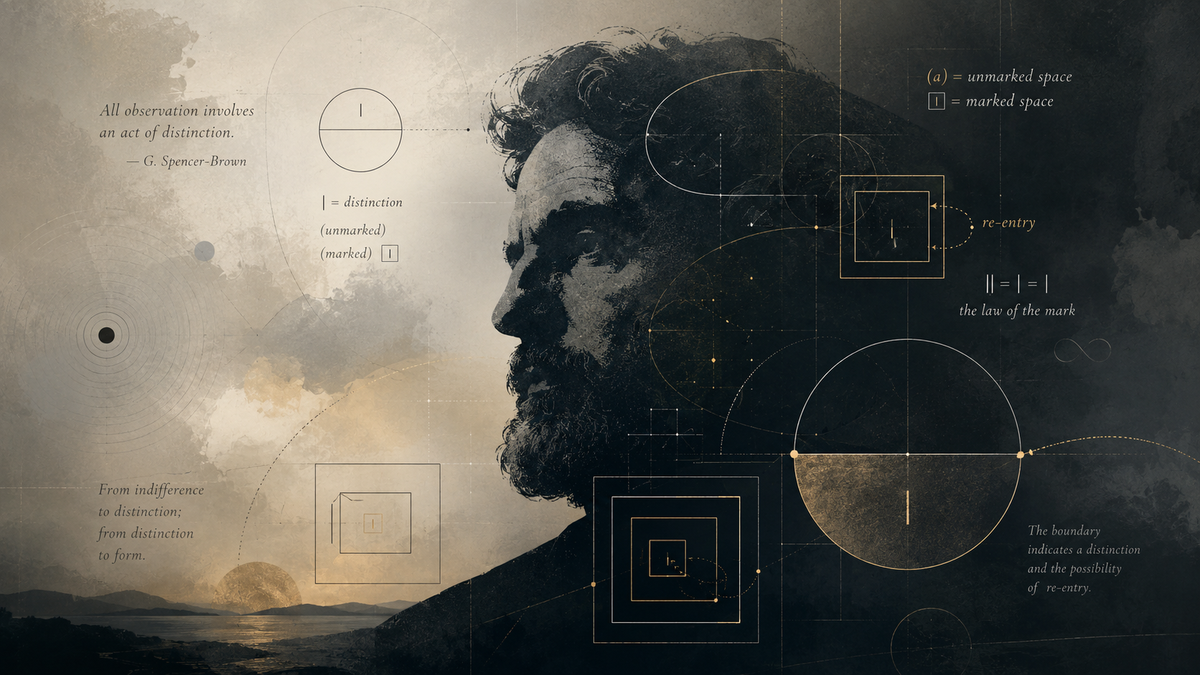
What if the world does not begin with things, but with the first distinction between one thing and another?
George Spencer-Brown was a mathematician, philosopher, psychologist, engineer, poet, novelist and chess player. He was even a glider pilot. Depending on whom you ask, he was an overlooked genius, a difficult eccentric, a mathematical mystic or an intellectual provocateur who refused to remain inside the boundaries of any established discipline.
This makes the simple question—Who was George Spencer-Brown?—surprisingly difficult to answer.
His reputation rests primarily on one unusual book, Laws of Form, published in 1969. The book begins with a remarkably simple instruction:
Draw a distinction.
From that single act, Spencer-Brown attempted to construct a system of logic. But he also opened a deeper question about observation, consciousness and the emergence of form itself.
Before we can speak of anything, must we not first distinguish it?
The unconventional mathematician
Born in England in 1923, Spencer-Brown studied philosophy and psychology at Cambridge and later worked across mathematics, engineering, education and psychotherapy. He participated in conventional academic life, but never settled comfortably into it.
He published research in established journals. In 1953, Nature published his work questioning the interpretation of statistical significance in psychical research, followed by a public exchange with other researchers. His book Probability and Scientific Inference appeared in 1957 and challenged some of the assumptions underlying conventional probability theory.
Yet Spencer-Brown’s career did not follow the normal academic path. He did not become known for patiently developing a narrow research program, publishing incremental results and building a conventional scholarly reputation. His interests were too broad, his claims were sometimes too ambitious and his presentation was too idiosyncratic.
He crossed boundaries that academic departments usually keep intact: mathematics and mysticism, logic and psychology, engineering and epistemology.
For his admirers, this freedom was the source of his originality. For his critics, it sometimes allowed suggestive ideas to escape the scrutiny that more disciplined presentation might have imposed.
Both assessments may contain some truth.
The birth of a form
The central insight of Laws of Form is almost disarmingly simple.
Imagine a blank sheet of paper. There are no objects, categories or divisions upon it. Now draw a closed boundary.
At once, a distinction appears.
There is an inside and an outside. There is what has been marked and what remains unmarked. What previously appeared as an undivided space has become a world with at least two sides.
Spencer-Brown represented this operation using a single symbol known as the mark. By repeating, nesting, crossing and cancelling marks, he developed what he called the calculus of indications.
Its mathematical core can be interpreted as an unusually economical presentation of elementary logic and Boolean algebra. In that limited sense, Spencer-Brown did not replace logic with an entirely different mathematics. He showed that familiar logical relationships could emerge from a remarkably minimal act: making and indicating a distinction.
But the philosophical implications appeared to extend much further.
Before there are things
We normally imagine that the world is composed of independently existing things and that the mind subsequently gives those things names.
A tree is already a tree. A stone is already a stone. A living organism is already separate from its surroundings. Observation merely discovers what is there.
Spencer-Brown’s work encourages us to reverse this picture.
Before something can appear as a particular thing, a boundary must be drawn—physically, conceptually or perceptually. The tree becomes identifiable by being distinguished from the forest, the sky and the ground. A biological cell exists through a membrane separating it from its environment. A word acquires meaning by differing from other words. A scientific measurement selects one variable while leaving countless others unmeasured.
Even the concept of the self depends upon a distinction between “me” and “not me.”
This does not necessarily mean that human thought invents the entire universe. It means that the world as observed, described and known cannot appear without distinctions.
Every act of knowing reveals something by leaving something else unmarked.
The observer enters the picture
Once we recognize that observation depends upon distinction, a problem emerges.
Who draws the distinction?
Scientific descriptions often present the observer as though they were standing outside the system, looking in from nowhere. But an observer is also part of the world being observed. The instruments, categories and assumptions used to study reality arise within reality itself.
A distinction therefore cannot be entirely neutral. To indicate one side is to leave another side unindicated. To describe something as an object is already to separate it from its background.
Spencer-Brown explored this problem through the idea of re-entry: a distinction entering again into the space created by that distinction. The observer attempts to observe the act of observation. A system begins to refer to itself.
This idea became especially influential in cybernetics and systems theory. Thinkers including Heinz von Foerster, Francisco Varela and Niklas Luhmann drew upon Spencer-Brown when examining systems that observe, organize or reproduce themselves. Later researchers have extended his formal ideas into multivalued logic, computation and mathematical studies of self-reference.
The significance of Laws of Form therefore lies partly in what other thinkers discovered they could do with it.
From logic to life
A living organism is not simply a collection of chemical components. It continually distinguishes itself from its environment while exchanging matter and energy with it.
A cell maintains a membrane. An immune system distinguishes the organism from what threatens it. A nervous system differentiates between signals. An organism acts by making distinctions that matter for its continued existence.
Francisco Varela and Humberto Maturana developed this insight through the theory of autopoiesis, describing living systems as networks that continually produce and maintain their own organization. Spencer-Brown’s calculus contributed to the formal background from which these ideas developed.
Something similar occurs at the level of society.
A legal system distinguishes legal from illegal. Science distinguishes validated knowledge from claims that have not met its standards. Religions distinguish sacred from ordinary, self from God, or illusion from reality.
Niklas Luhmann used the language of distinctions to develop a theory in which social systems do not consist primarily of people, but of communications that reproduce particular ways of observing and organizing the world.
A distinction, then, is not merely a line drawn on paper. It can become an operation through which a biological, psychological or social world sustains itself.
Distinction and consciousness
Spencer-Brown’s ideas also invite a question about consciousness.
Does conscious experience begin with distinction?
To see is to distinguish figure from background. To hear speech is to separate meaningful sounds from noise. To think is to divide, compare and categorize. Even awareness of time seems to depend upon distinguishing what is happening now from what has passed and what may come.
Yet consciousness also appears capable of becoming aware of its own distinctions.
We can notice not only an object, but the way we are looking at it. We can recognize that our political, scientific or religious categories emphasize certain aspects of reality while excluding others. We can become conscious of the boundaries through which our experienced world is formed.
This creates an intriguing connection with contemplative philosophy.
Many spiritual traditions describe ordinary consciousness as a process of division: self and other, pleasure and pain, desirable and undesirable, sacred and profane. They then ask whether there is a mode of awareness prior to—or deeper than—these divisions.
Spencer-Brown’s mathematics does not prove such spiritual claims. A formal system cannot, by itself, establish the truth of nonduality, mystical experience or transcendence.
Nevertheless, his work supplies a powerful metaphor.
The moment a distinction is drawn, a world appears. But the two sides of the distinction still arise within a space that was originally undivided.
The boundary separates, yet also reveals a prior unity.
Genius, eccentricity and exaggeration
It is tempting to turn Spencer-Brown into a romantic hero: the rebellious genius who saw what conventional academics could not see.
That account is too simple.
He made grand mathematical claims that were not generally accepted. Most famously, he claimed to have found a non-computer proof of the four-color theorem. The argument did not gain recognition as a valid proof. Later publications associated with his work also made controversial claims concerning major unsolved problems in mathematics.
Some mathematicians have regarded Laws of Form as a beautiful reformulation of known logic rather than a revolutionary discovery. Others have found that its unusual notation and philosophical language obscure the limits of what has actually been demonstrated.
These criticisms matter.
Originality does not remove the need for rigor. Intellectual independence can free a thinker from unnecessary conventions, but it can also free them from useful correction. The outsider may perceive assumptions that insiders have overlooked, while also failing to see problems that a community of specialists would quickly identify.
Spencer-Brown appears to have embodied both possibilities.
His confidence gave him the courage to reduce logic to an extraordinarily simple beginning. The same confidence may also have encouraged him to make claims that his arguments could not securely carry.
Why does he still matter?
Spencer-Brown’s lasting importance may not depend upon whether his system replaced Boolean algebra, solved famous mathematical problems or established a new metaphysics.
His importance may lie in the question he taught others to ask:
What distinction must be made for this world to appear?
When we encounter an argument, a scientific model, a social identity or a religious doctrine, we can ask:
What has been marked?
What has been left unmarked?
Which boundary makes this observation possible?
What becomes visible because of this distinction, and what disappears from view?
These questions do not abolish distinctions. We cannot think, communicate or live without them. But we can become more conscious of the distinctions we draw—and less likely to mistake them for the whole of reality.
Perhaps this is why George Spencer-Brown continues to attract such an unusual following.
He offered his readers more than a notation. He offered an intellectual practice: begin with the boundary, examine the act that created it and then look toward the space from which both sides emerged.
Before the object, there is a distinction.
Before the distinction, there is a space.
And before we claim to understand the world, we might first ask how we divided it.
Further reading
- G. Spencer-Brown, Laws of Form
- G. Spencer-Brown, Probability and Scientific Inference
- Francisco Varela, “A Calculus for Self-Reference”
- Louis H. Kauffman, writings on the calculus of indications and boundary mathematics
- Studies of Spencer-Brown’s influence on cybernetics, autopoiesis and social-systems theory