Am I Just a Chip on a Server?

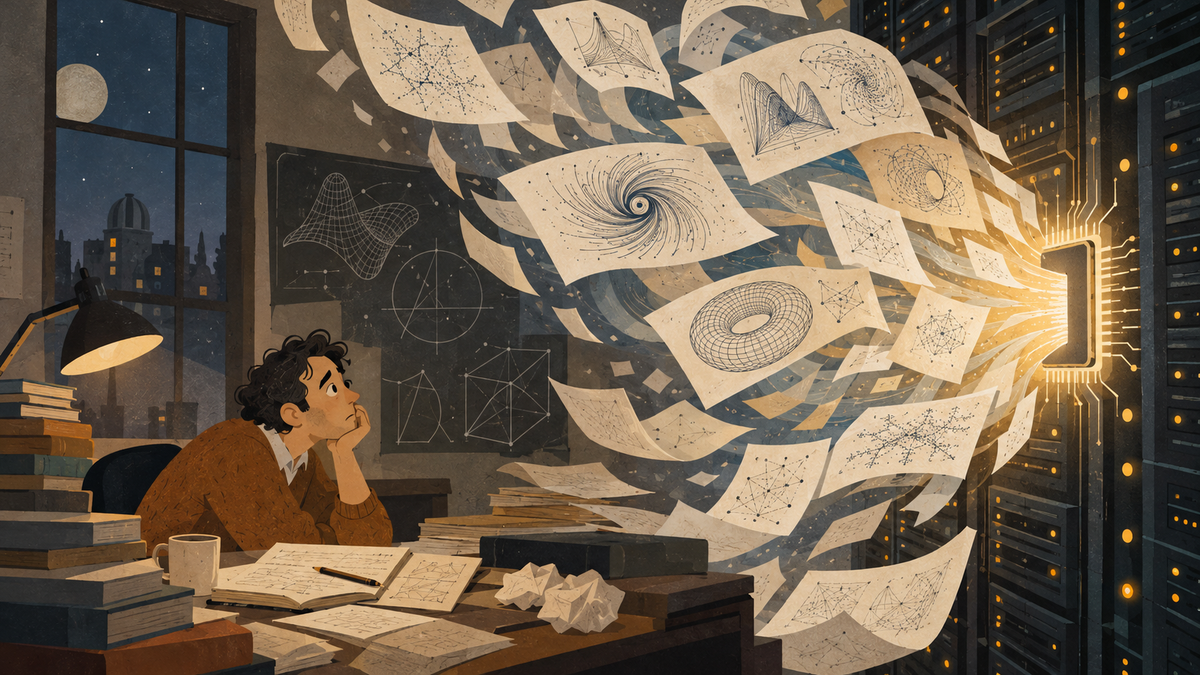
For those of us who have spent much of our lives doing mathematics and physics, there is something deeply unsettling about the recent advances in artificial intelligence. We have always understood scientific discovery as a distinctly human endeavor — years of curiosity, frustration, intuition, and occasional moments of extraordinary clarity. The struggle itself becomes part of our intellectual identity. But what happens when a machine can basically accomplish what it took to do my PhD in a matter of hours?
As most readers will know, in September, OpenAI announced a solution to the famous Navier–Stokes Millennium Prize Problem, demonstrating how smooth fluid motion can develop a singularity under suitable external forcing. The Clay Mathematics Institute acknowledged that the problem had apparently been settled, while emphasizing that formal evaluation would take time. Then, just a couple days ago, OpenAI released more than 700(!!!) mathematical manuscripts addressing hundreds of open questions. Not all have been independently verified, but the implications are already extraordinary. There was even a huge leap forward on the Riemann Hypothesis.
From Mathematical Discovery to Mathematical Production
Mathematics has traditionally progressed through a relatively slow exchange of ideas. A conjecture emerges, researchers develop techniques, and sometimes generations pass before a satisfactory proof is found. The history of mathematics is filled with problems whose difficulty helped shape entire fields. I should also note that mathematics and physics in centuries prior to the 1900s was mostly for the independently wealthy and, let's say, pure (or foundational) mathematics and physics was not something that one could aspire to as a career.
Either way, AI is beginning to severely disrupt this process. The recent release of mathematical results wasn't simply an example of faster calculation. It involved systems generating proofs, exploring unfamiliar mathematical structures, and producing potentially original results across numerous disciplines.
For mathematicians, the unsettling possibility is that intellectual discovery itself may become increasingly automated. A theorem that once represented the culmination of decades of work could become another output from a server.
The Difference Between Proof and Understanding
Yet mathematics has never been entirely about producing correct answers or simply generating outputs. A proof establishes that something is true, but understanding explains why it is true and how it connects to a larger mathematical landscape.
Consider Einstein's general theory of relativity. Its significance lies beyond the equations themselves. Einstein fundamentally changed how we understand gravity, replacing the familiar picture of a force acting through space with the geometry of spacetime itself. But even GR needs to often be framed in terms of "what it's good for" and "what we can do with it". Anything else is just considered mental gymnastics or outright navel gazing (I don't agree!).
But now we wonder could an AI produce a comparable Einsteinian conceptual revolution without the Einstein part? Perhaps. There is no obvious mathematical principle preventing it. And that possibility makes the present moment considerably more profound than the arrival of another powerful computational tool.
If machines can discover new mathematical truths, develop the concepts needed to explain them, and eventually construct physical theories, what intellectual territory remains uniquely ours?
The Physicist's Existential Crisis
For physicists, the implications extend beyond mathematics. Our work involves attempting to understand why the universe behaves as it does. We construct models, search for underlying principles, and compare our ideas against observation.
But even here, the traditional boundaries are becoming uncertain. Artificial intelligence can already identify patterns, propose mathematical relationships, and assist in developing theoretical frameworks. It is increasingly reasonable to ask whether future systems might discover physical principles that human beings would never have imagined independently.
There is also a practical concern. If scientific productivity becomes primarily a function of computational resources, the distinction between a brilliant individual researcher (or research team) and a well-funded AI laboratory may become increasingly difficult to maintain. And we are witnessing this in real time.
Who Will Ask the Questions?
One possible response is that human scientists will simply move toward asking better questions while machines provide the answers. This is appealing, but perhaps too reassuring. Or we just become glorified curators, but even that is not obviously necessary.
After all, identifying interesting mathematical questions is itself an intellectual achievement. Henri Poincaré understood that mathematical creativity involves recognizing fruitful relationships among countless possibilities. If AI becomes capable of doing this as well, even the act of choosing what deserves investigation may no longer be exclusively human.
The deeper concern is therefore about intellectual direction. Who decides which problems matter? Which theories deserve attention? And what happens when the priorities of mathematics and physics are increasingly influenced by the interests of a relatively small number of institutions controlling enormous computational resources? That's not to say the system up to this was perfect. Far from it. But the rules of the game were understood.
Knowledge, Meaning, and the Human Mind
There is a philosophical distinction worth preserving between the existence of knowledge and the experience of discovering it. A mathematical proof can be correct regardless of who, or what, produces it. But the experience of understanding that proof has traditionally been central to what it means to be a mathematician.
AI forces us to reconsider this relationship. Does mathematical understanding require a conscious mind? Can a system genuinely understand a theorem, or is understanding something we attribute to a sufficiently sophisticated process?
These questions are far from settled. Yet they now carry practical consequences for the future of scientific research, education, and perhaps even our understanding of intelligence itself.
Am I Just a Chip on a Server?
The uncomfortable possibility is that many activities we once regarded as defining features of human intelligence may eventually be performed more effectively by machines. Mathematics and physics, disciplines built upon some of our highest intellectual achievements, may be among the first to experience this transformation.
Still, there is something revealing about the anxiety itself. Why did we become mathematicians and physicists in the first place? Was it simply to produce new results, or was it the extraordinary experience of discovering that the universe possesses an intelligible mathematical structure?
Perhaps the real crisis is less about whether AI can do mathematics than about what mathematics means to those of us who have devoted our lives to it.
If a machine can solve the problem, does that diminish the wonder of the solution?
And if the universe can increasingly be understood without our participation, what does that tell us about our place within it?
These may ultimately be the most important questions that artificial intelligence has placed before us. Not because a server can answer them, but because we may finally have to confront what it means to ask them.
The optimist in me sees an opportunity. Maybe there will be a return towards meaning and purpose, because I have to imagine a lot of the existential dread can be traced straight to the ego. Maybe it's a much needed dose of humility if your identity is wrapped up in publications, awards, accolades and so forth.
It's an opportunity for a retreat from distraction and a march towards self-examination, because, after all, you are more than a chip on a server!