The Riemann Hypothesis Falls


For the past two+ years, I've been spending some of my spare time working on the Riemann hypothesis (RH) as a bit of a hobby. It is arguably the most famous unsolved problem in mathematics. Virtually everyone assumed it was true, but proving it was a nightmare. My approach was somewhat unconventional. Rather than attacking the problem through the usual machinery of number theory, I was interested in whether ideas from physics, particularly entropy and spectral theory, might reveal something about the mysterious distribution of prime numbers.
With the help of an AI assistant, I found some tantalizing results. Enough, in fact, to publish a couple of papers exploring the ideas. Nothing remotely resembling a proof of RH, mind you, but some interesting mathematical connections that seemed worth pursuing. In fact, what I (and an LLM) found appeared to be a genuine equivalence. But an equivalence is not a proof.
I was under no illusion that a solution was around the corner. Like many others, I imagined RH might survive another 50 years. After all, it had already resisted some of the greatest mathematical minds for more than a century and a half.
And then yesterday happened.
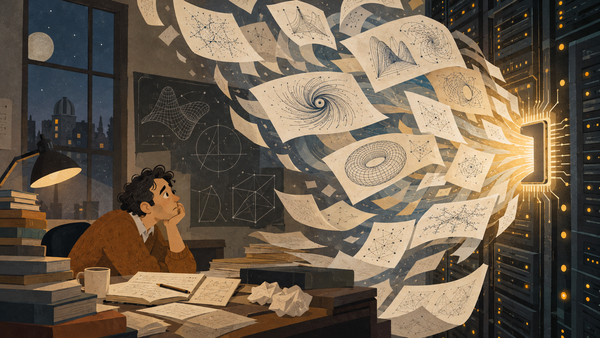
On November 20, mathematician Levent Alpöge announced that he and Anthropic's Claude had apparently proved the Riemann hypothesis, and even its more general form. The argument was released as roughly 17 million lines of formally checkable computer code! Independent verification is underway, and mathematical acceptance will take time, but the initial developments are extraordinary.
Just a few months ago, a different AI system announced a solution to the Navier–Stokes Millennium Prize Problem. These are problems that mathematicians expected to occupy generations of researchers. Now we're witnessing remarkable claims arrive within weeks of one another.
What on earth is happening?
The First Domino?
In retrospect, perhaps mathematics was always going to be the first major intellectual discipline to experience this kind of upheaval.
Mathematics is built upon logic. A mathematical proof, at least in principle, can be reduced to a sequence of logically valid steps. Unlike physics, where we must continually compare our theories against the physical world, mathematics possesses its own internal standards of correctness.
That makes it particularly amenable to computers. A sufficiently capable machine can explore possibilities, construct arguments, and verify logical relationships without needing to perform an experiment or look through a telescope. As one mathematician said, it takes a skilled jockey but an incredibly fast horse.
But there is something almost comical about the speed of the transformation. We spent centuries developing sophisticated mathematical tools, entire branches of mathematics, and communities devoted to solving a handful of extraordinarily difficult problems. Now some of those problems may be disappearing before we've even had time to properly understand the solutions.
And that last point is what interests me most.
A Proof Is Not an Explanation
Suppose the Riemann hypothesis really has been proved. What, exactly, have we gained?
Mathematically, an enormous amount. We would finally know that a particular statement about the zeros of the Riemann zeta function is true. Many conditional results throughout mathematics could potentially become unconditional.
But would we understand why it is true?
This is a distinction that physicists, in particular, should appreciate. We are not satisfied merely with equations that reproduce observations. We want to understand the underlying principles that make those equations work.
Newton could calculate planetary motion, but Einstein gave us a radically different understanding of gravity. The equations mattered, of course, but so did the extraordinary conceptual transformation.
The current RH announcement raises an unusual possibility: that a mathematical statement could be established through an argument so extensive that no human being initially possesses a coherent conceptual picture of the whole thing.
Perhaps a beautiful, relatively simple explanation will eventually emerge. I certainly hope so.
But we may be entering an era in which mathematical discovery routinely precedes mathematical understanding, sometimes by a considerable margin.
And there is no guarantee that human understanding will ever catch up with every machine-generated discovery.
The Students Are Not Happy
I've been speaking with young students about these developments, and some of their reactions have surprised me.
Some express a genuine anger. Some are beginning to reject AI altogether, not because they doubt its capabilities, but precisely because they recognize how powerful it is becoming.
They worry that something essential is being lost. That we are replacing the difficult, deeply personal experience of understanding with an industrial process for producing discoveries.
I understand the sentiment.
Imagine spending years studying mathematics because you dream of solving a great unsolved problem, only to discover that a machine may accomplish it before you've even finished your education.
What does intellectual achievement mean in such a world? What does it mean to dedicate your life to something that might become effectively automated?
I don't think dismissing these concerns as technological pessimism is particularly helpful. For many young people, this is an identity crisis unfolding before they've even had a chance to establish their intellectual identities.
At the same time, rejecting AI entirely seems unlikely to solve the problem. It is already becoming part of how mathematics and science are done. And as my own research experience illustrates, it can be an extraordinary intellectual companion.
The challenge is figuring out how to use it without surrendering the very intellectual curiosity that made us interested in science in the first place.
Perhaps We Have Been Asking the Wrong Question
There is a tempting response to all this: humans will discover meaning while machines discover facts.
I find that appealing, but perhaps a little too convenient.
Why assume that AI will remain incapable of producing insightful explanations, profound philosophical arguments, or conceptual breakthroughs? We shouldn't simply relocate human intellectual superiority to whichever territory machines have not yet occupied.
That would be a rather exhausting exercise!
Instead, I wonder whether the more interesting question concerns our relationship with knowledge itself.
For centuries, intellectual achievement has been intertwined with prestige, professional identity, publications, awards, and the satisfaction of being the first person to discover something.
There is nothing inherently wrong with these things. But perhaps we have become a little too attached to them.
Consider my own work on RH. If the conjecture has now been proved through an entirely different mathematical approach, does that somehow erase the value of the two years I spent exploring it?
I don't think so. I loved the exploration, and I learned a ton! I explored unexpected connections between physics and number theory. I developed ideas that perhaps may have significance independently of RH. And, perhaps most importantly, I enjoyed the process of trying to understand something mysterious.
Surely that counts for something, even if a machine eventually reaches the finish line first.
The Return of Lived Philosophy?
This brings me to the glass-half-full side of the situation.
Perhaps the extraordinary acceleration of intellectual discovery will create an equally extraordinary need for philosophy. Not philosophy merely as an academic discipline, producing more papers and arguments, but philosophy as something actually lived.
For most of human history, philosophical traditions were concerned with questions of meaning, purpose, self-knowledge, and how one ought to live. Philosophical understanding was not simply the accumulation of information. It was supposed to transform the person who acquired it.
One can read every book ever written about compassion without becoming compassionate. One can possess an encyclopedic knowledge of ethics without becoming an ethical person.
And one can have access to a perfect mathematical proof without personally understanding the mathematics.
These distinctions may become increasingly important.
Of course, AI may eventually become better than we are at explaining philosophy, too. But there remains a difference between receiving a remarkable explanation of how to live and actually living that way.
The latter is not merely a problem to be solved. It is something we must participate in.
Maybe this is where the real opportunity lies. As scientific knowledge becomes increasingly abundant, perhaps we will be forced to confront questions that intellectual achievement alone could never answer.
What is knowledge for? What is a meaningful life? What are we actually trying to accomplish with all this extraordinary intelligence?
And why did we become so convinced that producing knowledge was the same thing as possessing wisdom?
The Mystery Isn't Gone
I have no idea how mathematics, physics, or intellectual life more generally will look ten years from now. I'm not even particularly confident about ten days from now!
But I suspect we are witnessing something much larger than the automation of mathematical research.
The ability to discover new truths may be becoming less scarce. Yet our need to make sense of those truths, to integrate them into our understanding of ourselves and the world, is not disappearing.
If anything, it may become more urgent.
As for the Riemann hypothesis, I still find the idea that entropy might illuminate the structure of prime numbers fascinating. A proof of RH, assuming the current announcement survives scrutiny, does not automatically explain every mathematical or physical relationship surrounding it.
There will still be plenty to explore.
Perhaps the greatest irony is that the more mysteries AI helps us solve, the more directly we may be confronted with the oldest philosophical mysteries of all.
Not simply what can be known, but why knowledge matters. Not merely what intelligence can accomplish, but what makes a life worth living.
And perhaps, after a few centuries of increasingly specialized intellectual achievement, that would not be such a terrible direction for humanity to rediscover.